23 February 2026
How to Choose the Best Rain Pipe / Rain Hose for Farming
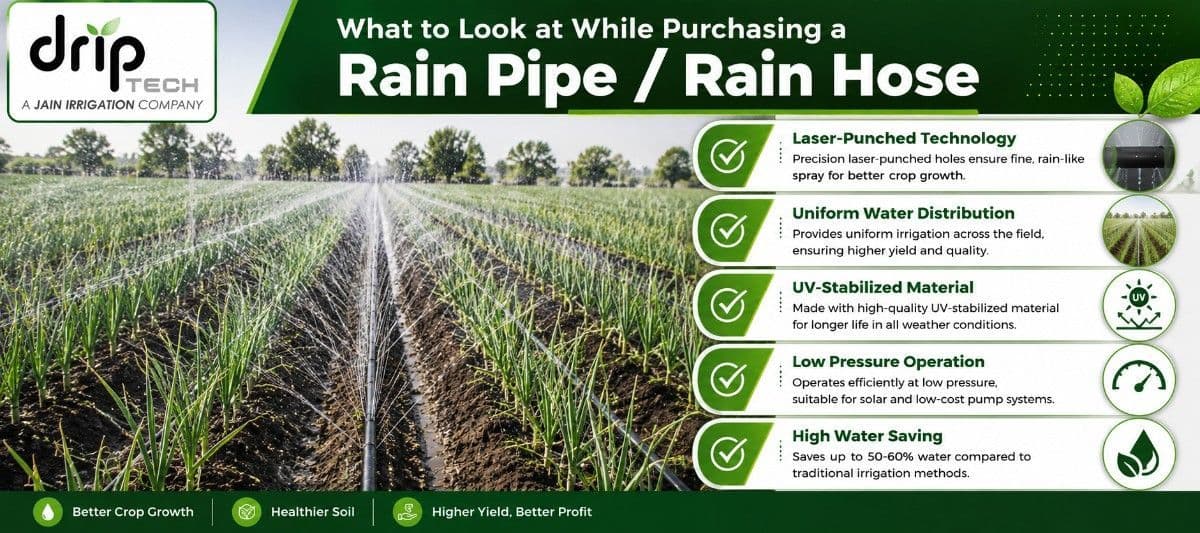
What to look at while purchasing a Rain Pipe / Rain Hose
There are many rain pipes / rain hoses available in the market from various manufacturers. They all look alike and most of them are priced at more or less the same level. The dealers / retailers attract the vulnerable farmers with discounts and sales talk. But though all the rain pipes / rain hoses look the same and are attractively packaged, they perform differently. Many rain pipes / rain hoses disappoint the farmers by not delivering the expected performance or by simply developing cracks or by bursting at normal working pressure. So, a farmer must know the features to look for before buying and evaluate his options and also take reference from the existing user of the brand in order to avoid a rude shock after the purchase. Here are some of the points a farmer should look into while purchasing a rain pipe / rain hose.
Wetting distance:
Wetting distance is the distance up to which a rain pipe / rain hose irrigates on its two sides. Please see the figure below to understand the wetting distance.


Figure 1
Longer the wetting distance the more is the interval between the rain pipe / rain hose. The more the
Interval, the less is the number of rain pipes / rain hoses needed for a given area. So, this has a direct relation with the quantity of rain pipe / rain hose needed for a given area which directly relates to the cost of the irrigation system. The images below will clarify this. Wetting distance of rain pipes / rain hoses of 32 /40 mm can vary from 3 mtr to 7 mtr.


Figure 2
Maximum Permissible Running Length:
Maximum Permissible Running Length represents how long the rain pipe / rain hose can irrigate the field on its two sides properly and uniformly. The water jets on sides taper off after a certain distance. The distance up to which the Rain Pipe / Rain Hose irrigates the promised wetting distance on two sides properly is the Maximum Permissible Running Length. Please see the figure 1 above to understand this. At the end of the Max Permissible Running Length, one has to put a new sub-mail line. So, higher is the Max Permissible Running Length, lower the number of sub-main required. The diagrams below (Figure 3) illustrate this. The diagrams are an illustrative layout of a Rain Pipe / Rain Hose system for 1 hectare by an ordinary Rain Pipe / Rain Hose and a good quality one. As you can see, the good quality ones need lesser quantity of Main Line, Sub Main Line, control valves and end caps making it an economical choice.


Figure 3
Overall, there can be great variation of the quantities of the components needed for the irrigation system with good quality rain pipe / rain hose and the ordinary ones. Here is an idea of how much it can vary:

Therefore, farmers should not look at the only cost of the rain pipe / rain hose but, evaluate the quantity of the rain pipe and the other components like main line, sub-mail line, valves and end cap required and the total cost of the irrigation system while choosing a brand of rain pipe.
Cheap rain pipe (low cost per meter / roll) but high cost of the irrigation system made with it (cost per acre) is often the case. So, beware! Don’t compare only the pipe price — compare the total irrigation system cost.
Uniformity of Irrigation:
It is most important to check whether the rain pipe / rain hose is irrigating the area uniformly. The ones
with not so good quality leave dry patches in the plot or flood the some of the pockets. Please check from the existing user farmers how the rain pipe / rain hose brand you want to buy is performing in the field; does it give uniform irrigation or are there dry patches?
Uniformity of irrigation comes from the design of pattern of the emitting holes and uniformity of the hole sizes. It is a result of the sophistication of the manufacturer’s technology and machinery.
You will find that the water drops coming out from the good quality rain pipe / rain hoses are very fine, whereas in most of the cases they are bigger drops which can harm fruits and flowers.
Life and Reliability of the product:
There is widespread complaint from the farmers about breaking / cracking of the rain pipes / rain hoses and their life is uncertain. The ones of good quality, however, do not disappoint the users. The ones made of High Quality Virgin Plastic last long, do not develop cracks just like that and last long; they are reliable. So, one has to enquire about the user farmer feedback about the quality of the brand of rain pipe / rain hose one intends to buy. Checking user farmers’ feedback from the internet can help.
Frequently Asked Questions (FAQs)
1. What is the most important factor to check while purchasing a Rain Pipe / Rain Hose?
Answer-The most important factors are Wetting Distance, Maximum Permissible Running Length, uniformity of irrigation, durability, and product reliability.
2. What is the wetting distance in a Rain Pipe / Rain Hose?
Answer- Wetting distance is the width of the area irrigated on both sides of the Rain Pipe / Rain Hose. A longer wetting distance allows greater spacing between pipes and reduces the quantity of pipes required.
3. Why is wider wetting distance beneficial?
Answer- A wider wetting distance reduces the number of Rain Pipes / Rain Hoses needed for a field, which lowers the overall irrigation system cost.
4. What is Maximum Permissible Running Length?
Answer- It is the maximum length up to which the Rain Pipe / Rain Hose can irrigate uniformly and effectively from start to end without significant reduction in water distribution.
5. Why is Maximum Permissible Running Length important?
Answer- A higher running length reduces the need for additional sub-main lines, valves, fittings, and end caps, making the irrigation system more economical.
6. How can farmers check irrigation uniformity before purchasing?
Answer- Farmers should visit existing users of the brand and observe whether the Rain Pipe / Rain Hose irrigates uniformly or leaves dry patches and over watered spots.
7. What causes poor irrigation uniformity in some Rain Pipes / Rain Hoses?
Answer- Poor quality manufacturing, uneven hole sizes, improper emitting hole pattern design can result in uneven water distribution.
8. Why is the size of water droplets important?
Answer- Fine water droplets are safer for delicate crops, flowers, and fruits, while large droplets may damage crops and compact the soil.
9. Why do some Rain Pipes / Rain Hoses crack or burst?
Answer- Low-quality materials and poor manufacturing can cause cracking or bursting under normal operating pressure.
10. Which material is best for durable Rain Pipes / Rain Hoses?
Answer- Rain Pipes / Rain Hoses made from high-quality virgin plastic are generally more durable, crack-resistant, and long-lasting.
11. How can farmers verify the reliability of a Rain Pipe / Rain Hose brand?
Answer- Farmers should take feedback from existing users, dealers, and online reviews before making a purchase decision.
12. Why should farmers not buy Rain Pipes / Rain Hoses based only on price?
Answer- There can be a huge difference in the quantity of rain pipe / rain hose and other components required for an irrigation system when using a high-quality rain pipe/rain hose compared to ordinary products.
As a result, an irrigation system using a low-cost Rain Pipe may actually become more expensive due to the requirement of:
- larger quantities of spray pipes,
- more fittings,
- additional valves,
- more sub-main and mainline pipes,
Thus, while the per-meter or per-roll price of an ordinary Rain Pipe may appear low, the total cost of the complete irrigation system can turn out to be substantially higher. Low Rain Pipe cost… but high irrigation system cost!
Besides, many products may appear similar and may even be attractively priced. However, their performance, durability, and irrigation quality can vary significantly.