17 January 2026
Laser Spray Jumbo Rain Pipe / Rain Hose (Laser Spray) | Driptech
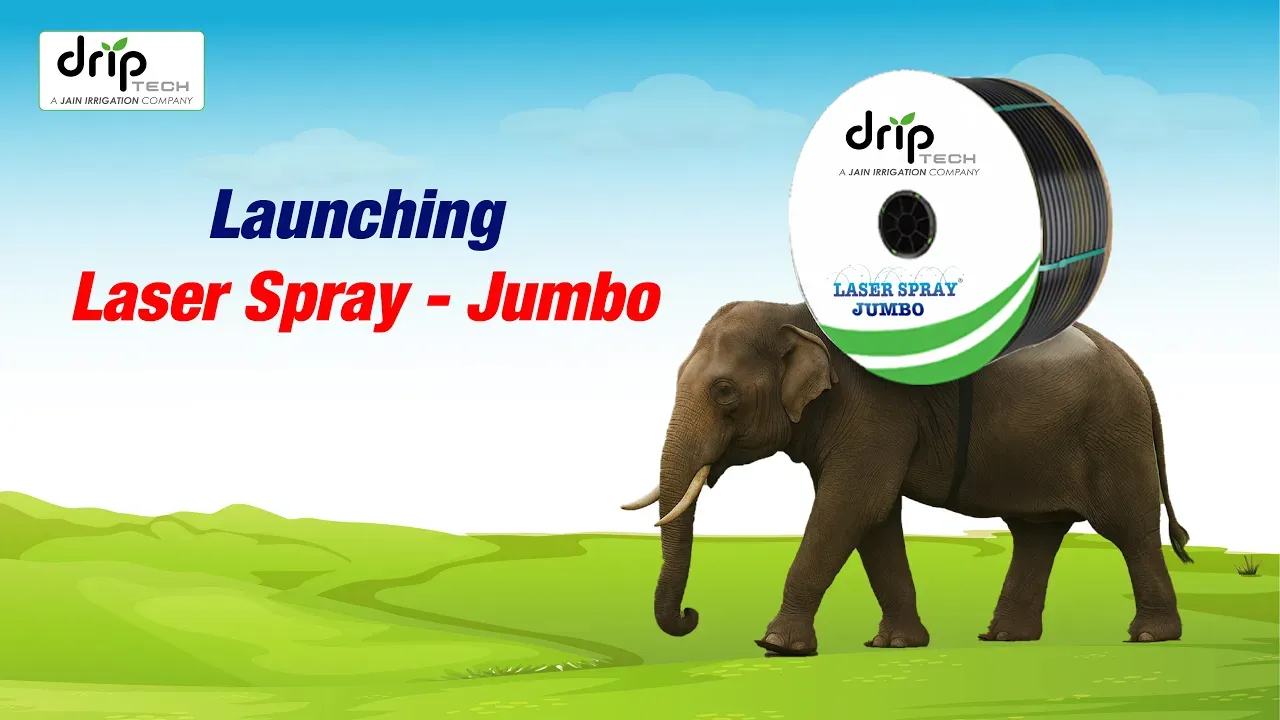
Laser Spray-Jumbo, commonly called Rain Pipe / Rain Hose– The Next Generation Irrigation Innovation
Introduction
Introducing the Laser Spray-Jumbo (Rain Pipe / Rain Hose) — a cutting-edge addition to the Laser Spray family of irrigation solutions. Designed with precision engineering and advanced polymer technology, this new model offers broader coverage, higher durability, and superior performance — making it an ideal solution.
About the Laser Spray (Rain Pipe / Rain Hose) Technology
Laser Spray irrigation, also known as Rain Pipe or Rain Hose irrigation, is an advanced form of micro-irrigation that simulates natural rainfall. The hose is made from high-grade polyethylene and features laser-punched holes that release fine water droplets evenly across the field.
Unique Benefits of Spray Irrigation
Laser Spray (Rain Pipe / Rain Hose) irrigation is technically called Spray Irrigation and it substitutes traditional sprinkler irrigation. It stands out with many benefits:
- Supports Photosynthesis: Clean, healthy leaves are key to efficient photosynthesis. By preventing dust buildup on leaves, the Laser Spray (Rain Pipe) ensures that your plants absorb sunlight more effectively, enhancing growth and yield.
- Gentle on Crops: The Laser Spray (Rain Pipe / Rain Hose) disperses fine water droplets, ensuring that your delicate fruits and flowers aren’t damaged during irrigation. This gentle spray mimics natural drizzle, making it ideal for maintaining healthy crops.
- Boosts Soil Health and Germination: The Laser Spray (Rain Pipe) irrigation keeps the soil porous, which improves air circulation around the roots and enhances seed germination. By spreading water evenly across the soil surface, it also reduces the risk of waterlogging and seepage loss.
- Perfect for Sandy Soil: Sandy soils, notorious for their quick drainage, benefit immensely from the Laser Spray’s (Rain Pipe) thin water distribution on the soil. The water penetrates efficiently, keeping the soil moist without being wasted.
- Washes away Insects: Its rain like watering of the plant washes away the insects resulting in reduction crop protection spray of insecticides.
- Cooling the crop: It cools the crop canopy as well as the soil and thus saves the plants form heat stress.
What is the new Laser Spray Jumbo model?
Laser Spray (Rain Pipe / Rain Hose) substitutes the Sprinkler Irrigation. Most of the farmers in India uses Quick Release Coupling (QRC) HDPE pipes and Sprinkler Nozzles. But they normally possess inadequate number of components required for their land. The practice is to invest in 25 numbers and 5 numbers of QRC pipes and Sprinkler nozzles respectively for 1 acre of land. These quantities are sufficient only for part of 1 acre land. So, they irrigate the part of the land required with the above pipes and nozzles, and then shift them to the other parts one by one and complete the irrigation of the whole area in several shifts. An acre of land with the above number of components will need roughly five shifts. This calls for a lot of labour and time.
The new Laser Spray Jumbo can be used to irrigate by shifting a single Laser Spray pipe over an area like the sprinkler described above. The advantages are:
- It is highly economical.
- Since just a single light weight pipe is to be shifted, it calls for minimal labour.
- It saves time.
Further, Laser Spray ( Rain Pipe / Rain Hose) has several advantages over Sprinkler:
| Laser Spray | Sprinkler |
Working Pressure | 0.7 kg / cm2 | 1.5 to 4 kg/cm2 |
Pump Required | Lower HP | Higher HP |
Electricity Consumption | Low | High |
Maintenance | Low. No moving rart | Higher |
Harm to Fruits and Flowers by the water jets | No | Possible |
Compaction of soil | No | Possible |
Technical Highlights (Approximate Specifications)
Parameter | Specification |
|---|---|
Model | Laser Spray 63 mm |
Material | High-quality polyethylene (UV stabilized) |
Spray Width | Up to 12–15 meters (depending on pressure and layout) |
Recommended Length | Up to 100 meters per line |
Working Pressure | 1.0 – 2.5 kg/cm² |
Hole Type | Laser-punched, self-cleaning |
Installation | Quick-connect coupler system |
Ideal Crops | Sugarcane, Maize, Groundnut, Fodder, Pulses, Vegetables |
(Note: Actual performance may vary depending on pressure, field layout, and water source.
Here is video of Laser Spray Jumbo (63 mm) which explain the above: https://www.youtube.com/watch?v=nFElw-6IF_k
Conclusion
The Laser Spray-Jumbo represents a breakthrough in the field of micro-irrigation — combining technology, efficiency, and practicality. Designed to provide rain-like irrigation at low cost, it ensures optimal soil moisture, reduced labor, time and improved crop quality.
FAQ
1. What is Laser Spray-Jumbo (Rain Pipe / Rain Hose)?
Laser Spray-Jumbo is a model of Laser Spray family manufactured by Driptech India. It is of largest size ( 63 mm diameter) among the family. It is generally used as single pipe to irrigate a plot of land by shifting it like a sprinkler irrigation system is used.
Like all Laser Spray models ( commonly called Rain Pipe / Rain Hose), it has laser-punched holes to deliver uniform, rain-like irrigation and works under low pressure. But it gives much higher discharge than the other models.
2. How is Laser Spray-Jumbo different from regular Rain Pipe or Sprinkler irrigation?
Comparison with other Rain Pipes / Rain Hoses:
- It is made of larger diameter pipe (63 mm)
- It is highest discharge among the rain pipes.
- It has wide coverage / wetting distance (7 mtr)
- It has long running length (100 meters)
Like Sprinkler Irrigation system, it is used for irrigating a part of the land and then shifted to other parts to complete the irrigation of the whole land in shifts. However, in this case only a single Laser Spray pipe is shifted unlike in case of sprinkler where the QRC HDPE pipes and sprinkler nozzles are shifted. Thus there is huge saving in drudgery, time and labour.
The advantages over sprinkler system are:
- Saving of labour.
- Saving of time
- Highly economical
- Requires low maintenance as there is no moving part unlike in sprinkler.
- Works of low pressure ( 0.7kg/cm2 as against 1-4 kg/cm2 for sprinklers
- Requires smaller HP pumps
- Saves electricity
- Laser Spray has fine droplets which does not harm fruits and flower which is a possibility in sprinkler having large water drops
- Laser Spray’s fine droplets dot not compact soil which is often the case with sprinkler with its water jets hitting the ground at high speed.
3. Why is Laser Spray-Jumbo more economical than sprinkler systems?
Unlike sprinklers that require multiple QRC pipes and nozzles to irrigate one acre in shifts, Laser Spray-Jumbo allows irrigation by shifting a single pipe across the field.
Apart from the investment irrigation system, there is huge saving in:
- The pump as smaller HP pump is required due to meet the low pressure requirement of Laser Spray
- Saving in electricity as low HP pump is used
- Saving in labour as only a light weight spray pipe is shifted whereas in case of sprinkler, a number of QRC HDPE pipes and Sprinkler nozzles with Riser pipes are to be shifted.
4. What type of crops are suitable for Laser Spray-Jumbo?
It is suitable for all short height close spacing crops like cabbage, onion, radish, soyabean, gram, paddy and wheat etc.
5. Does Laser Spray-Jumbo support better germination?
Yes. Like all Laser Spray model ( Rain Pipe / Rain hose), its fine, uniform spray keeps the soil moist and porous. The seepage under ground is limited and so the porosity in the soil is maintained. There is also no crust formation and waterlogging. As a result, the germination is better.
6. Is Laser Spray-Jumbo suitable for sandy soil?
Absolutely. Sandy soils drain water quickly, but Laser Spray-Jumbo lile all other Laser Spray models applies water gently, evenly and spreading thinly over the soil surface. As a result the seepage is minimal.
7. Does Laser Spray-Jumbo help in pest and dust control?
Yes. The rain-like spray washes away the insects and thus reducing the pest infestation.
8. Can Laser Spray-Jumbo reduce heat stress in crops?
Yes. The fine spray cools the crop canopy, the soil surface and the micro environment helping crops withstand high temperatures and reducing heat stress damage.
9. What pressure is required to operate Laser Spray-Jumbo?
Laser Spray-Jumbo operates at 0.7 kg/cm².
10. Does Laser Spray-Jumbo require high-power pumps?
No. Because it works at low pressure (0.7 kg/cm2), it requires lower horsepower pumps, making it energy-efficient and suitable for solar-powered irrigation systems.
11. Is maintenance required for Laser Spray-Jumbo?
Maintenance is minimal because:
- There are no moving parts
- Laser-punched holes are self-cleaning
- No nozzles to replace or clog frequently
12. How much labor is needed to operate Laser Spray-Jumbo?
Very little labor is required. Since only one lightweight pipe is shifted across the field, irrigation becomes faster and less physically demanding compared to sprinkler setups.
13. Can Laser Spray-Jumbo damage flowers or fruits?
No. The fine water droplets of Laser Spray-Jumbo or the Laser Spray models do not harm delicate flowers, fruits, or tender leaves—unlike high-pressure sprinkler jets.
14. What is the recommended length for one Laser Spray-Jumbo line?
A single Laser Spray-Jumbo (63 mm) line can be laid up to 100 meters which is it Max Permissible Running Length while operating at its working pressure of 0.7kg/cm2.
15. Is Laser Spray-Jumbo suitable for Indian farming conditions?
Yes. It is suitable for the conditions of low pressure availability, high labor costs and the need for cost-effective irrigation solutions.
16. What is the main advantage of Laser Spray-Jumbo for farmers?
The biggest advantage is uniform irrigation with lower cost, lower labor, lower electricity consumption, and better crop health, making it a next-generation irrigation solution.